

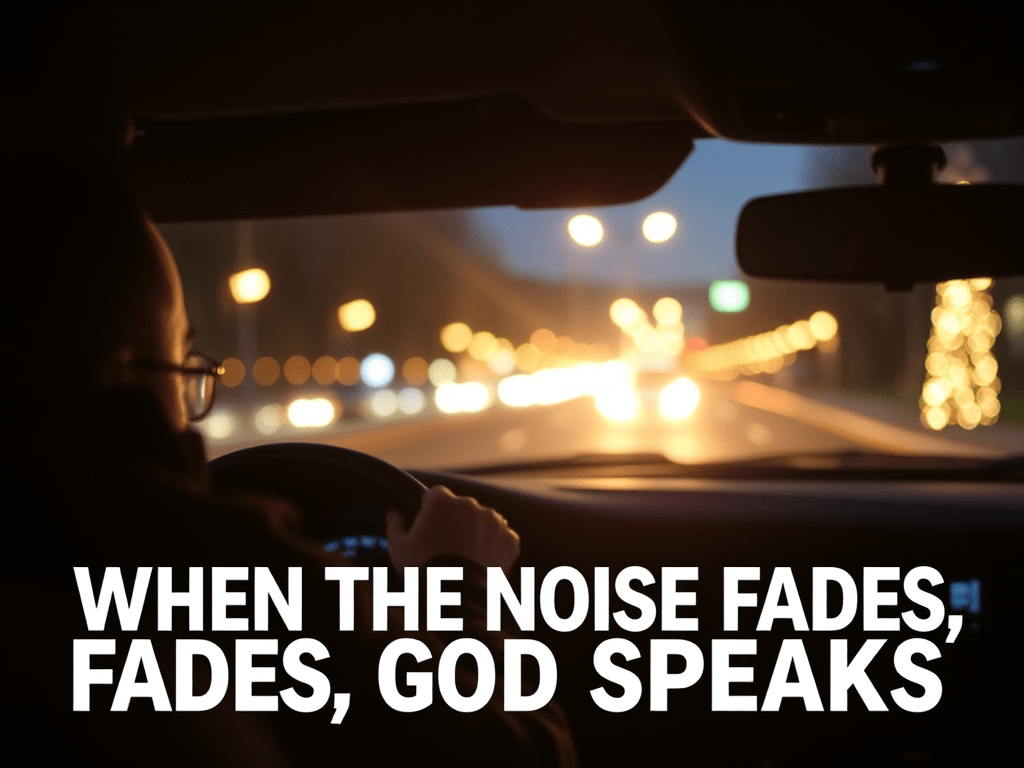
Have you ever been driving in your car when the music is so loud you can’t think? You don’t turn it down because the song is bad—you turn it down because you need to hear something else. Maybe it’s a child asking a question from the back seat, directions you don’t want to miss, or a warning sound coming from the engine.
Christmas can feel the same way.
There is so much music this time of year—songs, traditions, schedules, expectations—that the most important truth of the season can get drowned out. All month long, we talk about the songs surrounding Jesus’ birth. Mary sang. Zechariah sang. The angels sang. Simeon sang. But before any of them lifted their voices, God did something even more profound.
He spoke.
That’s where the Gospel of John begins the Christmas story—not with a manger, shepherds, or angels, but with a sentence that turns the volume down: “In the beginning was the Word, and the Word was with God, and the Word was God” (John 1:1, ESV). Before there were Christmas songs, before there were Christmas trees, before the world even existed, Jesus was already there.
John’s opening words intentionally echo Genesis. Before brokenness, heartache, sin, and grief entered the story, there was Jesus. Christmas is not a detour in the Bible—it’s the restart button. It’s God stepping into a broken world with a promise of peace, purpose, love, hope, and joy.
And when God finally came, He didn’t come loudly. There were no fireworks, no palace, no parade. He came as a baby, in a small town, on a quiet night. John tells us, “He was in the world… yet the world did not know him” (John 1:10). That still feels painfully relevant. Christmas gets loud—shopping lists, busy calendars, family stress, and unmet expectations—and sometimes we miss Jesus not because He is distant, but because He comes gently.
Then John gives us one of the most beautiful and challenging lines in Scripture: “And the Word became flesh and dwelt among us” (John 1:14). When John says “flesh,” he uses the word sarx—a word that points to weakness, hunger, fatigue, and mortality. He could have said Jesus became human, but he chose a word that reminds us just how fragile humanity is. God didn’t wear humanity like a costume. He embraced it fully. Jesus knew hunger, thirst, exhaustion, and sleep. If Jesus got tired, then your exhaustion isn’t a spiritual failure—it’s human.
Jesus also entered the human timeline. He didn’t arrive fully grown. He learned to walk, speak, read Scripture, and obey. The God who holds eternity submitted Himself to process. Growth matters. Waiting isn’t wasted. Spiritual formation takes time.
John also tells us that the Word “dwelt” among us—a word that literally means “to pitch a tent.” It’s tabernacle language. In the Old Testament, if you wanted to meet with God, you went to the tent, followed the rules, brought a sacrifice, and kept your distance. But at Christmas, God does something shocking. He doesn’t wait for us to come to Him. He comes to us. The Word becomes flesh and pitches His tent in our world. God didn’t come to be visited; He came to be known.
And John reminds us that the light shines in the darkness, and the darkness has not overcome it. Just like a single candle can push back a dark room, Jesus brings light when we’re afraid, guilty, hurting, or uncertain about what’s next. Christmas Eve reminds us that the darkness didn’t stop Him then—and it can’t stop Him now.
The invitation of Christmas is simple. Receiving Jesus doesn’t mean having everything figured out. It means opening your heart and saying, “Jesus, I need You. Come close to me.” And the good news is this: He already has.
 Upside Down Faith