The Mirror of the Cross

We begin each day by looking in the mirror. It’s one of the first things we do—brushing our teeth, fixing our hair, applying makeup, adjusting our clothes. And just before we leave the house, we give ourselves one last look to make sure everything is in place. Even throughout the day, we catch our reflection in car mirrors, glass doors, and passing windows. Whether consciously or not, we are always checking—always looking.

Why is that? Because a mirror reflects what’s in front of it. It shows us if something’s off, out of place, or in need of attention. We rely on it to correct our appearance before facing the world. But what if there’s something deeper we need to examine—something a mirror cannot show?

The Gospel of Matthew, chapter 27, gives us a different kind of mirror. It’s not glass or metal, and it doesn’t reflect our face—it reflects our soul. This chapter doesn’t simply tell the story of Jesus’ suffering and crucifixion; it invites us to step into it. It asks us to slow down, to observe carefully, and to ask ourselves the uncomfortable question: What does the cross reveal about me?

The chapter opens with Judas, one of Jesus’ closest followers, who returns the thirty pieces of silver he received for betraying his Lord. Stricken with guilt, he confesses, “I have sinned.” But instead of returning to Jesus, he isolates himself in despair and ultimately takes his own life. The religious leaders, unmoved by his remorse, coldly dismiss him. In this moment, we see the devastating weight of sin carried alone—and the danger of refusing to turn back to the one person who could forgive and restore.

This image forces us to look inward. How do we handle our own guilt and failure? Do we try to manage it ourselves, hiding our shame and carrying the weight alone? Or do we bring our brokenness to Jesus, who willingly carried our sins in His own body? The cross is not a place of condemnation, but of healing. It reminds us that our sins are far too heavy to bear on our own—but Jesus has already borne them for us.

As the story continues, Pontius Pilate, the Roman governor, presents a choice to the crowd: release Jesus or Barabbas, a known criminal. The people, stirred by fear and pressure, choose Barabbas. Pilate, despite knowing Jesus is innocent, yields to the crowd and washes his hands of responsibility. We see here how easy it is to make the wrong choice when under pressure—how quickly conviction can be sacrificed on the altar of convenience.

Each of us faces our own daily choices between truth and compromise. When the pressure mounts—when we’re tired, stressed, or afraid—do we stand firm, or do we fold? The crowd’s decision wasn’t just a moment in history; it’s a pattern that repeats itself in our lives every time we choose what is easy over what is right.

Then comes the mockery. Jesus is beaten, clothed in a robe of scorn, crowned with thorns, and paraded as a fake king. Even as He hangs on the cross, the insults continue. The Son of God is humiliated by those He came to save. And yet, He endures it without retaliation. This part of the story is perhaps the most piercing, because it asks us a difficult question: Do we, in our own way, mock Jesus too?

Not always with our words—but perhaps with our lives. When we say we follow Him but ignore His call to forgive, to love, to live humbly and purely, are we not contradicting our confession? When we compartmentalize our faith—keeping it in church on Sunday but absent from our decisions, our relationships, and our priorities the rest of the week—are we not acting like those who mocked Him, while claiming to know Him? Mockery doesn’t always sound loud—it can whisper quietly through compromise and indifference.

At the moment of Jesus’ death, something extraordinary happens. Darkness falls, the earth shakes, and the curtain in the temple—the thick veil that separated God’s holy presence from the people—is torn from top to bottom. This was no accident. The tearing of the curtain was a divine declaration: the way to God is now open. No longer does access to the Father depend on priests, rituals, or temple sacrifices. Jesus has become the final, once-for-all sacrifice. In His death, He removes the barriers between us and God.

This act reshapes how we approach our Creator. We are no longer outsiders, hoping for a glimpse of His presence. We are welcomed in. We can speak to Him directly, worship freely, and walk with Him daily—not because we have earned the right, but because Christ has made a way.

But do we live like that’s true? Do we approach God with boldness, or do we hold back, forgetting the wonder of what has been done for us? The torn curtain reminds us not only that God is accessible, but that His presence is with us always—at home, at work, in joy, and in sorrow. He is not confined to a building. His Spirit dwells within His people.

As the chapter draws to a close, the noise and chaos fade into silence. Jesus is taken down from the cross. A man named Joseph of Arimathea, risking his reputation, gives Jesus a proper burial. A few faithful women remain nearby, watching, waiting, grieving. They don’t preach or perform miracles. They simply stay. Quiet, steady, present.

There’s something holy about their silence. In a world that often values loud declarations and visible results, their faithfulness reminds us that sometimes, the truest devotion is quiet. Sometimes it looks like showing up when no one else does. Remaining when others walk away. Believing when hope feels thin.

Waiting on God doesn’t always come with answers or resolution. But faithfulness in the waiting means holding on—believing that even in silence, He is working. Like Joseph and the women, we are invited to stay close, even when the light dims and the path ahead is unclear.

And so, we return to where we began—looking in the mirror. But not just the one that reflects our face. There is another mirror now, the cross, standing tall and unflinching, reflecting what we cannot always see on our own. In its shadow, we are asked: Who am I in this story? Pilate, washing his hands? The crowd, choosing the easier path? The soldiers, mocking what they do not understand? Or Joseph and the women, quietly faithful?

The mirror shows us not just who we are, but who we are invited to become. Because in the end, the cross is not only a symbol of suffering. It is the place where love triumphed, mercy poured out, and the door to God was flung wide open—for you, for me, for all.


Finding Jesus in Everyday Moments

When I was younger, I was fascinated by space. I remember scanning the school course listings and hoping—every year—that an astronomy class might finally be offered. It never was. But that didn’t stop me from wondering.

Years later, I found myself standing under a clear, star-filled sky on a summer night. No city lights. No telescope. Just the vastness of it all. It left me in awe. I remember thinking, “God, You made all of this. And yet… You see me too?”

There’s something about moments like that—when we feel small but somehow seen. Maybe that’s why Easter hits differently. It reminds us that the God who hung the stars also walked dusty roads. He felt hunger, heartbreak, rejection. And He went all the way to the cross… for us.

This is a first century ancient tomb with the stone rolled aside in Israel. This is similar to the type Jesus would have been buried in .

But that’s not the end of the story.

In Matthew 28, we find two women—Mary Magdalene and “the other Mary”—heading to the tomb. They’re not expecting a miracle. They’re going to mourn. But then, a violent earthquake shakes the ground, an angel rolls back the stone, and says words that would change everything:
“He is not here; He has risen, just as He said.”

Can you imagine their shock? Their joy? Their confusion?

Then suddenly—Jesus meets them. Right there on the road. “Greetings,” He says. Simple. Personal. Not thundering from the heavens, but close enough to touch.

That same day, two of His followers are walking to Emmaus – heads down and hearts heavy. A stranger joins them—walks beside them, listens to their sadness, and begins to teach. It’s only later, while breaking bread, that their eyes are opened.
It was Jesus all along.

They just hadn’t recognized Him.

How often does that happen to us?

We’re grieving, busy, doubting, distracted… and we miss Him. But Easter reminds us:
Jesus is closer than you may realize.

He comes in the ordinary. He meets us on the road, in our questions, in our quiet places of pain. He speaks our name, just like He did to Mary. He walks alongside us, just like He did on the road to Emmaus.

Maybe this Easter, you’re not feeling especially “spiritual.” Maybe life feels heavy, uncertain, or just plain full. But here’s the good news: You don’t have to reach up to heaven to find Jesus. He’s already near.
In your questions. In your wonder. In your hurt. In your hope.

He draws near not only in the miraculous but in the mundane. In the breaking of bread. In the kindness of a friend. In the quiet moments when your soul whispers, “Could it be Him?”
The empty tomb isn’t just about what happened long ago. It’s about what’s true right now.
Jesus is alive. And He is closer than you may realize.

Leaving a Legacy of Hope

  I have been thinking a lot about legacy lately. My wife and I have been married for 20 years and have two amazing daughters. Our oldest just turned 15 and the reality of her impending adulthood hit me hard a few months ago. I remember when she was born, people would tell me over and over again, “It will go by fast!” At first, I though they were delusional. All those sleepless nights as an infant and then those restless days of chasing a toddler certainly seemed to drag on. But somewhere between losing her first tooth and getting her driver’s permit the world skipped a decade!

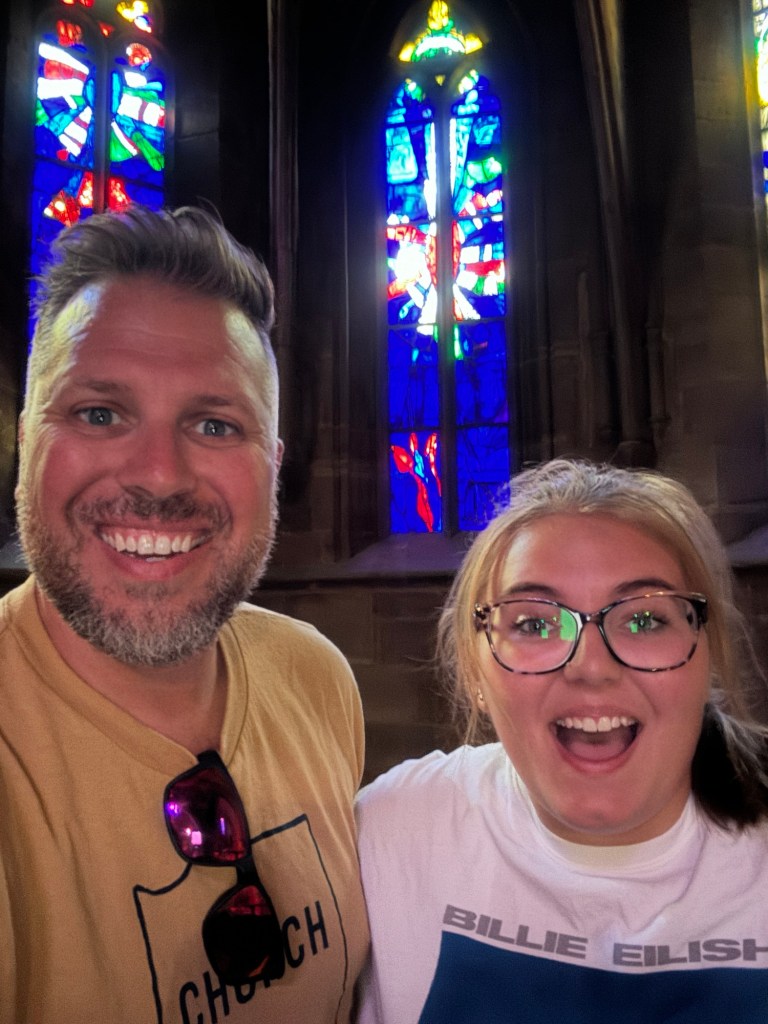
            Over the summer I had a chance to take her to Germany with our church. It dawned on me as we walked the streets of Heidelberg that my ancestors walked those very same steps along the Reine River over 200 years ago. My ancestors experienced religious and political oppression as they pastored the villages up and down the river. The persecution was so harsh that it forced my ancestors to immigrate to the United States where they settled in Pennsylvania, Indiana, and the Cumberland Gap in Kentucky. Generation after generation, the men in our family would pastor churches and farm. Even my great grandparents were founding supporters of Grace College in Winona Lake, IN in 1948.

            All of this reminiscing reminded me of the words found in Deuteronomy 6.5-7, “Love the LORD your God with all your heart, with all your should, and with all your strength. These words that I am giving you today are to be in your heart. Repeat them to your children. Talk about them when you sit in your house and when you walk along the road, when you lie down and when you get up.”

            I cannot help but be grateful for the faithfulness of my family over the centuries as they have loved the LORD with all their hearts. As we returned home from Germany, it was impressed on mine that as a father, a husband, and as a Christian, I am also responsible to leave a legacy for the next generation. God has called all believers to be people of faith and hope. To live in way that brings glory to Him, in all things. To let our words proclaim life and our actions to align with the truth we profess.

            As you consider your own family and community, what are the ways you can instill a legacy of hope for the next generation? Does that look like being committed to your local church on a weekly basis? Does that sound like joyful and hope-filled conversations with your kids, grandkids, nieces, and nephews? How can you Love the LORD with all your heart?  How can you live for Jesus in such a way that impacts your family generations from now?

Do You Hear What I Hear?

Do You Hear What I Hear? was written in 1962, a time in American history where

the threat of war and instability were very much concerning. The race to the moon had just

been established, the country was in the middle of the Cold War, and the Cuban Missile

Crisis had just begun.

For some like myself, these moments are just footnotes in a history book – but for

others, they are still fresh in your minds. For those of us who did not experience these

episodes, we must understand it was a time of uncertainty and fear.

Noel Regney, one of the song writers, was in New York City and watching babies being

pushed in strollers on the sidewalks. In that moment, with chaos – uncertainty – and fear of

war surrounding the country, she was inspired to write the lyrics, “Pray for peace, people

everywhere.”

One of the greatest gifts that Jesus has given us is Peace. But the peace He gives is

much different than the type of peace the world is used to.

Jesus said, “Peace I leave with you. MY peace I give to you…” (John 14.27).

The Peace of Christ is more than an absence of war. The peace of Christ is genuinely

a tranquil state of the soul, and the mind, where you fear nothing from God, and you are

content with what He has entrusted you with. This is the same peace that Jesus had the

night He was wrongfully arrested. The same peace He had while He was beaten, mocked,

and crucified.

It is this peace, “My peace,” Jesus said that He is giving to you. As we celebrate

Christmas in the coming days we need to understand that the birth of Christ was a

necessary moment in God’s plan and design for our lives and His purpose. The peace that

Jesus gives us is the kind of peace that cannot be explained. When world says panic, the

Peace of Christ makes us calm. When the world says to seek vengeance, the Peace of

Christ shows forgiveness. When the world says, “It’s ok to act out and be angry,” the Peace

of Christ says, “It is well with my soul.”

This gift of peace, comfort, and contentment is only possible because, Jesus, “though

he was God, he did not think of equality with God as something to cling to,” (Philippians

2.6).

John Lennon once said, “If someone thinks that peace and love are just a cliché that

must have been left behind in the 60s, that’s a problem. Peace and love are eternal.”

John wasn’t wrong. Peace and love are eternal – but they are only possible through

faith in Christ. Jesus said, ‘God loved the world so much that He sent His one and only Son,

so that everyone who believes in Him will not perish but have eternal life” (John 3.16).

This season, let us celebrate the birth of Jesus and hold on to the promise of peace that

only He can provide.

Compelled to Thanksgiving

“Thank you.” “I appreciate you.” “You’re great.” “You’re the best.”

These are all ways that we often share our gratitude toward people. There is a moment in Paul’s letter to the people of Philippi where he says, Every time I think of you, I give thanks to my God. – Philippians 1.3 (NLT)

In this proclamation, he raises the standard of expectation and thankfulness. He tells the people of Philippi, not only is he grateful for them, but that the actually tells God about how much they mean to him whenever he thinks about them!

A few months ago, I received a phone call from a mother. It turns out that my oldest daughter, Brooklyn, and her daughter share some of the same classes together. This mother called to tell me how grateful she was for Brooklyn’s impact in the life of her own daughter. Apparently, Brooklyn stood up to a bully and then acted in a moment of compassion that this other girl desperately needed.

Then about a month ago, my wife and I received a series of emails and messages from different teachers who felt compelled to share similar stories about Brooklyn’s joy and the impact she was making for Christ in the lives of students and teachers.

I know it sounds like I’m bragging a little on my daughter…because I am! And that’s the point! That is what Paul was doing every time he approached God in prayer. When he was thinking of the people who blessed him, encouraged him, and served him…Paul found it necessary to tell God about it! He was compelled to brag on another one of God’s children because of the impact they made in his own life. 

I have two questions for us as we go into this season of thanksgiving. 

My first question is simple: Who are the people in your life that you value enough to thank God for? Husband? Wife? Daughter? Son? Brother? Sister? Friend? Co-worker? Who are they and when was the last time you genuinely thanked God for them?

The second question is a little more difficult: Am I treating other people in such a way that they are compelled to thank God for me? 

Jesus said, “By this all will know that you are My disciples, if you have love for one another.” – John 13.35 (NKJV)

As we move into a week and a season of thankfulness, may our hearts be open and grateful for the relationships that God has given us. Let us pursue a life of love in both word and deed. May we treat each other with the kindness, compassion, mercy, and grace that Christ has shown to us all.  

Happy Thanksgiving!

I’m Too Busy!

“Rest.” “Be Still.” “Wait upon the Lord.”

You will find these words and commands mentioned over 200 times in the Bible. But when someone asks the question, “How are you doing?”, how often do you say, “Busy!” “I’m swamped.” “Can’t get ahead!”

It seems that we often take pride in the busyness of our lives. We work more than 40 hours a week, spend 10-15 hours driving kids around in the evening, and eating fast food in between stops. We go to meetings, check out at the new store in town, pick up groceries, and then chase the kids around the house trying to get them to shower, brush their teeth, and go to bed. 

By then you feel like you need some “me time.” So you grab a book or turn on the TV only to fall asleep before you can really enjoy either. Then you wake up and do it all again. And that’s just during the week!

On the weekends we load up the car and go to games, concerts, visit family, attend weddings, mow the lawn, and pick up the house. If we are really good, we might actually put away the laundry and clean the garage! 

Somewhere along the line we bought into the lie that “Busyness leads to happiness.” While it has been proven that productivity is good for our mental health, there is also a fine line where too much is just too much. At that point, we become stressed, anxious, frustrated, and easily irritated.  

That is why God has instructed mankind to rest. Take a break. Sit. Be still. Know that He is God. It’s hard to do! I know this personally. The truth is, I’m supposed to be resting as I write this!

I stepped outside to enjoy the sunset and listen to the birds as they flew in and out the pond behind our house. But I kept thinking, “David. You’re behind schedule. It’s time to write another blog.”

Rest doesn’t come easy to most of us. It is a discipline that requires intentionality and accountability. When we learn to rest in the way that God desires us to rest, we will walk away from those moments with a calmness of heart, new energy, and a better understanding of God’s purpose for our lives.

Biblical rest is a rest that can promotes peace, ease, or refreshment. Rest can take many forms. Taking a nap. Sitting down with friends and having a conversation. Playing a board game. Reading a book. Building something with your hands. Watching a movie. The idea is that when you finish your time of rest you feel better. Your mind is sharpened, health is restored, and your heart is refocused on God.

In fact, resting is an act of worship! God wants us to consider Him in all that we do. When we rest and refocus on our relationship with God, that means that we get to carry that newness of life with us into the busyness of our week.

We get to shed the light of Jesus on the people we meet at those ballgames, dance rehearsals, weddings, and concerts! 

Wherever you find yourself on the spectrum of busyness this week, don’t forget to make time to rest. As for me, I’m going to wrap this up and finish watching the sunset before I miss a chance to draw closer to God.

Living Hope

Photo by Tim Gouw on Pexels.com

Hope is an interesting thing isn’t it. The Oxford dictionary defines hope as a feeling or expectation and desire for a certain thing to happen. Recently, my family and I were visiting my sister and brother-in-law in Minneapolis, MN and we attended a Major League Baseball game. This was the first professional sporting event my daughters (13 & 9) had ever attended. Our family plays soccer and golf, so trying to teach our girls about baseball on the fly was a sight to behold.

The game was close the entire time – neither team leading by more than one run. It was the bottom of the ninth inning and the home team, the Minnesota Twins, were down by one. The ballpark was a place filled with hope as the fans desperately wanted to see their team win.

There was one out and one runner on base. As the next batter walked up to the plate, I looked at my daughter and said, “If he hits a homerun right now, they will win, and the crowd will go wild!” 

First pitch. Hit! It went long to the left field and just out of bounds as it passed the yellow pole and over the fence. Foul ball. One strike.

Second pitch. Strike two!

I leaned over again and reminded her that a home run will win it all!

Third pitch. Bam! The ball came off the bat with a fiery fury that led no doubt that this game was over. The crowd began to cheer! Fans hugging and high fiving each other. Just for a moment, a band of strangers were united in the realization of their hope!

After the game was over, we stayed around for the fireworks and walked back to where we were staying. That moment has passed now and the hope we shared is over. It just a memory.

It was the Apostle Peter who coined the phrase “Living Hope.” He understood that Jesus not only brought the promise of eternal life for all who believe, Jesus also promises to be our Living Hope right now!

The great thing about Living Hope is that, unlike what we experienced at that baseball game, the hope we have in Jesus will never stop. 

To the Christian, I want to encourage you, don’t give up hope. Whatever you’re going through right now, know that God’s plans are always greater than your own. Jesus is alive and God has promised to never leave you or abandoned you. The world we live in is difficult on all accounts. But Jesus said, “Take heart! I have overcome the world!” – John 16.33c

To the seeker and the skeptic, God’s love for you is beyond description. He desires for you to know Him and to know His love. In a world where all hope seems lost, know that the greatest hope of all time has a name, and His name is Jesus. He is not lost. He is alive. He is not temporary. He is forever. 

Don’t Miss It

The Gospel of Mark has become one of my absolute favorite reads of all-time! I have spent the better part of 18 months digging into this gospel during my personal study time. The themes of urgency, intentionality, and perseverance are so practical and applicable to our lives.

Recently, I was teaching the high school students at our church on a Wednesday night. We are exploring Mark’s Gospel together over the next few weeks. It’s been a joy to share with them the things that God has revealed to me in His Word. As I was teaching, I pointed out that people tended to have an “immediate” response to Jesus. Additionally, Jesus responded with immediacy when it came to ministering and caring for others.

As we were surveying the first few chapters, we discovered the ways in which Jesus served. He performed healings, teachings, exorcisms, and miracles. In the sixth chapter of Mark’s Gospel we discover that Jesus sends out His disciples, two by two, to do ministry. After some time had passed, they returned to Jesus to share all that they had done and taught.

There is this sense of excitement and fatigue at the same time! So what happens next? A crowd makes their way to Jesus and the next thing we know He is feeding thousands of people with only 5 loaves of bread and two fish!

Imagine the exhaustion of Jesus and the disciples. The disciples had been on the road for some time – serving and teaching – only to return to another incredible ministry opportunity that seemed to blow right over their heads.

Mark tells us that following the feeding of 5,000, Jesus sent the disciples on a boat toward another town. He then dismisses the crowd and Jesus goes up to the mountain to pray. As Jesus is looking over the water He notices that the disciples were having a hard time making their way across the sea. The winds were strong and the waters would have been choppy to say the least.

Jesus makes His way down the mountain, casually walks across the water, and intends on passing by the disciples who were struggling in the boat. The disciples see Jesus from a distance and confuse Him for a ghost. Jesus speaks words of peace and makes His way towards the men. The disciples were terrified as Jesus got into the boat and the waters stopped.

Some amazing things just transpired! However, the disciples were so busy trying to be obedient – teaching, serving, and healing – that they missed the miracles happening all around them. They missed Jesus create baskets of leftover food when it seemed there wasn’t even enough food for a small group. They missed Jesus walking on the water. They missed Him controlling the raging seas. In fact, they were so caught up on trying to figure out how Jesus fed all those people that they missed the peace that Jesus brought when He was in their presence.

How well can we relate to the disciples? Think about it for a moment. Reflect on your own life. I know I’ve been reflecting on mine.

Do you find yourself working so hard to make Jesus happy that you forget to take a moment and rest with Him? Are you serving your church, community, and family to the point of exhaustion – but lack joy? Has life been so all-consuming that you find yourself asking Jesus where He is?

Well, I’ve been there too. I want to encourage you in this today: Jesus has not left you. He is working all around you and sometimes even through you. Take notice of Mark’s observations and guard your hearts from spiritual busyness. Find rest, joy, and peace in the presence of Christ.

Comfort & Fear

I have come to realize the scariest and most comforting place to be is in the midst of God’s Will. It’s scary because the details are uncertain. It’s comforting because I know Who is writing my story. God says, “’For I know the plans I have for you,’ declares the LORD, ‘plans to prosper you and not to harm you, plans to give you hope and a future,’” (Jeremiah 29.11).

One of those moments for me took place during the summer of 2002. I had just finished my freshman year of college and accepted a youth ministry internship at the small church in which I had made a profession of faith 11 years earlier. My relationship with the church was rekindled when I asked the pastor to baptize me just before my college career began. We had stayed in touch over the past 8 months, which led to my internship.

I had known for a couple of years that the Lord was calling into fulltime ministry. However, I had no idea what that even looked like. With one year of college education under my belt I was highly unequipped to lead in the areas for which I was responsible.  I’ll never forget the day I was literally handed the keys to the church and then told by the pastor that he was going to be out of town for a week. You need to understand, cellphones were not an everyday thing at this point in history. So I was truly on my own.

Ministry is a serious calling. It is not something that should ever be taken lightly. The Apostle Paul tells Timothy that some have the desire to minister but not everyone is equipped. I had the desire. I didn’t know if I was equipped. The only thing I knew for sure was to be completely dependent on God.

That summer transformed my prayer life and affirmed my calling. I preached my first sermon. I led a weeklong retreat for students. I learned how to negotiate pricing on building rentals and booking bands. I rallied my friends to partner with me in ministry.  I ordered way too much food for events and lost all track of time when leading weekly student events. We had a lot of fun. But more importantly, we made a big deal out of Jesus.

I look back on those days and I am reminded of God’s faithfulness through the uncertainties around me. What I didn’t tell you is that was also the summer my mom had been diagnosed with skin cancer. She had the spot on her arm removed but was unable to go to work until she was fully recovered. In my experience, cancer is a nasty beast that causes just as much emotional damage as it does physically. The moment the possibility of a diagnosis is announced, the mind starts going places it should never go to. The fear of the unknown can overwhelm you. It can rob you from your sleep, distract you from what is important, and cloud your judgment.

Today I praise God that my mom made a full recovery and has been cancer free for 16 years!

Paul has taught us that God’s Will is good, it’s pleasing, and it’s perfect (Rom. 12.2). Walking through that season with my family was one of the scariest moments of my life. I didn’t know much about cancer at the time so my mind was an awful place to visit. I was serving in a capacity in which I was fully unprepared and uneducated. That season of my life drove me to my knees and taught me that living in God’s Will can be the scariest and most comforting place to be.

Can You Hear Me Now?

Do you remember the Verizon commercials from a few years back? The one where Paul Marcarelli was the “Test Guy.” Paul would find himself in hard-to-reach places and ask the question, “Can you hear me now?” You could see Paul on a tropical island, Rocky Mountains, desert, or on a boat in the middle of the Hudson River. Verizon was trying to communicate that their signal was strong and you wouldn’t experience a poor connection with them – unlike their competitors. Verizon was confident that they had the best cellular phone coverage than anyone else in the country.

With that in mind, this has been one of the busiest summers of my life.  I have visited seven different states, racked up over 5,000 miles of road time, camped in the Rocky Mountains, swam in the Gulf of Mexico, and floated down the Current River. I just wrapped up a two-week journey of teaching and hosting “equipping conferences” for the Kentucky Baptist Convention. In the middle of all this travel I have been working on strengthening our church discipleship strategy, expanding our student ministry efforts, and preparing for future events and assignments. Our family expanded by two cats (what was I thinking?!), our girls started school again, and my wife had surgery.

It would be an understatement to say that there were moments when I have felt overwhelmed over the past few months. There were days when my plate was so heavy that I didn’t want to get out of bed. Then there were days where the burden was so overloaded that I couldn’t fall asleep. Sometimes the days would run into each other and I didn’t know if it was Tuesday or Friday.

My world had been so clouded with decisions, uncertainties, and deadlines that I found myself relying more on ibuprofen and coffee than on the promises of God’s Word. It’s not like I wasn’t reading Scripture or burying myself in teaching, preaching, and podcasts. In fact, I was deeply intentional about being filled with truth. The issue was that somewhere inside of me, between my heart and my mind, there was a “poor connection.”

It was as if God was asking, “Can you hear me now?”

My response was, “Are you still there? God. I’m trying to connect with you but I can’t hear.”

“I’m here David. Listen carefully.”

“God…I’m trying…I need you. Where are you?”

“David. I’m right here. I’ve never left you. I’m here.”

It wasn’t until recently when a friend of mine made a comment about his own life that my connection with God strengthened. Considering his circumstances, my friend said, “If I believe in the sovereignty of God then I have to believe there is a reason for all this.”

Those words of reflection instantly resonated with my heart. It was like God was still saying, “Can you hear my now? I know your life. I know your heart. I know your burden. There’s a purpose for all this. I have great plans for you. My Son’s burden is light. Give it to Him. I’ll give you clarity.”

The Bible teaches us that God speaks to us in several ways – His Word, the Spirit, His Son, creation, and other people. In fact, Paul wrote to the church in Ephesus, “Rather, speaking the truth in love, we are to grow up in every way into him who is the head, into Christ…”

Just think about it, if God can use a donkey to speak (Num. 22.28), he can certainly use someone in your life! So here I am, finally hearing the truth that I’ve been pursuing for months. It just took a while to connect.

Here’s the point of this pastor’s confession. Whatever your circumstance – be faithful in your pursuit of God and don’t be discouraged if your connection seems weak.It is easy to try to take our lives into our own hands. It’s easy to lean on our own wisdom, experience, and knowledge. It’s easy to take control. However, if I believe in the sovereignty of God, then I have to believe His Word when he says, “Trust in the Lord with all your heart and lean not on your own understanding; in all your ways submit to him, and he will make your paths straight (Proverbs 3.5-6).”

The kicker is this – I still don’t know what caused the “poor connection.” I’m not sure what was keeping me from hearing truth. I can’t pinpoint a moment that led to cloudiness or burden. But in many ways I can relate to the blind man in John 9 when he said, “One thing I do know, I once was blind, but now I see!”

My prayer is that whatever cloud you’re walking through, whatever uncertainties you face, whatever fears are keeping you from moving forward – may you see clearly the promises of God and experience His presence in a vibrant and life-changing way!